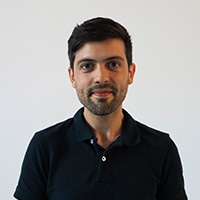
Joana Vaz Pinto (J.V. Pinto) is an Assistant Professor and researcher at NOVA School of Science and Technology (NOVA FCT).
Joana graduated in Physics Engineering in 2001 and was awarded with her PhD degree in Applied Physics in 2008 from NOVA-FCT
where she gained expertise in the use of ion beam techniques to characterize and modify the magnetic and electrical properties
of metal oxide materials. In October 2008, J.V. Pinto joined CENIMAT with a PostDoc position aiming at the development Field
Effect Transistors and Devices for biosensing applications (ISFETs. Her current research is focused on patterning methodologies
and development of thin film devices in ultra thin parylene membranes for conformable electronics. She has been exploiting
this polymer in its wide range of applications as substrate, dielectric and encapsulation layers for a broad range of devices,
like TFTs, capacitive/resistive sensors, RFID antennas, solar cells, memory based devices and electrochromic cells. Her main
objectives are pursuing the integration on parylene ultra-thin membranes of devices to achieve self-powered sensing platforms
combining the group expertise in fabrication and circuit design. She has supervised more than 30 Msc thesis in the last 6
years. She Published 70 papers in peer review journals ( h-index of 25, April 2025) and has 1 book chapter. She has been
actively participating in national funded projects (Neuroxide, SMARTEDGE) and international research Projects ( i-Flexis,
1D-NEON, SUPERSMART, DIGISMART, FOXES, EMERGE, SYNERGY) with both academia and industry. She is currently the national coordinator/partner
Leader of a EU funded project (SUPERIOT - Truly Sustainable Printed Electronics-based IoT Combining Optical and Radio Wireless
Technologies - www.superiot.eu) ) led by University of Oulu, Finland, that started in January 2023. The main effort on SUPERIOT
apart from fabricating Supercapacitors and Sensors is on selecting innovative routes for the integration of devices of different
partners (combining different processes, substrates and materials) in to a combined demonstrator. A summary of my main
research and academic activities: Main teaching activities: Microelectronics Processes and Microelectronics Systems and
Devices; Micro Fabrication and Advanced Characterization of nanostructures; Electronic Data Storage; Characterization tools
expertise: XRD and AFM with special focus on in-situ methodologies; Electrical characterization of thin films and devices;
Electrochemical characterization of devices Fabrication tools expertise: Thin film deposition techniques based on PVD (sputtering
and e-beam evaporation) and CVD (parylene deposition); Patterning by Conventional photolithography and micro structuring by
colloidal lithography. Main research areas: i) Flexible Electronics: A great effort over the last years on implementing
parylene layers in Flexible electronics either as substrate, as transistor dielectric or as passivation/encapsulation layers.
More recently on the microstruturing of Parylene by colloidal lithography and its use to enhance solar cells performance.
ii) Resistive pressure, temperature and UV sensors; iii) energy based devices and in particular solar cells whit parylene
active coatings and substrates and Micro Supercapacitors based on 2D inks and nanostructured materials.















































































 Campus da FCT Quinta da Torre
 (+351) 21 294 8562
 cenimat.secretariado@fct.unl.pt