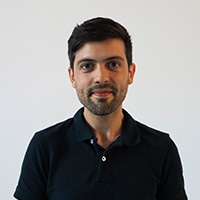
Francisco Seco (FC Seco), Research Assistant at the Bioinspired Peptide Systems Lab (Ana Pina Lab) at ITQB-NOVA. As a biochemist,

my commitment to understanding the molecular complexity of life has evolved into a focused interest in developing peptide-based
diagnostic platforms.
Fueled by a deep interest in biology and chemistry, I pursued a bachelor’s degree in Biochemistry at FCT NOVA in 2018, graduating
with a grade of 16, placing me in the top quartile of my class. This foundational education solidified my proficiency in life
sciences. During my final year, I completed my project with the NMR research group at FCT-NOVA on "Characterization of the
interaction of the C-terminal domain of endolysin Twort with the peptidoglycan of S. aureus," aimed at developing a potencial
tool to combat multi-resistant S. aureus infections using enzymes, thus decreasing antimicrobial resistance. This enhanced
my knowledge of structural biochemistry, particularly through NMR techniques.
During my project, I co-authored a poster presented at Microbiotec21, gaining valuable experience in scientific communication.
Intrigued by this project, after my graduation in 2021, I pursued a summer internship in the same lab to deepen my practical
skills. My commitment to biochemistry led me to a master’s degree, which I completed with a grade of 18/20 at FCT-NOVA, earning
recognition as the top student for 2023/2024.
In 2022, I was awarded the "VERÃO COM CIÊNCIA" 2022 scholarship funded by FCT-MCTES, which allowed me to continue my research
on the project. Subsequently, I conducted my master's thesis on "S. aureus Peptidoglycan recognition by SH3b domains," still
within the NMR research group, completing the research I began during my bachelor’s project and contributing to advances in
the field. In addition to deepening my NMR techniques through various experiments, I expanded my knowledge in microbiology.
I also presented this work at the “Annual Master’s Dissertations” event from the Chemistry Department at FCT-NOVA.
Building on my expertise in NMR, in early 2024, I was selected for a fellowship within the project "Revolutionizing Electronic
Skin: Biobatteries Powered by Collagen-based Biomaterials," funded by the "La Caixa" Foundation and Innovalley PoC, in collaboration
between ITQB NOVA and Cenimat/I3N, to elucidate the structure of collagen-mimetic peptides. This critical work is aimed at
establishing a foundation for peptide-based platforms, unlocking their potential to power biobatteries and advance the field
of bioelectronics.
Based on this work, I presented the poster “Collagen Mimetic Peptides Reimagined: The Role of Non-Biased Sequences in Structural
Integrity” as first author and contributed as co-author to the poster “Functionalization of Supramolecular Peptide Materials
for Electrochemical Applications.” Both were presented at the XIX Iberian Peptide Meeting held in Santiago de Compostela,
Spain. Additionally, I contributed as co-first author to a review manuscript, currently available as a preprint on ChemRxiv.
In October 2024, I further expanded my expertise by participating in the CERMAX Practical Course on Basic NMR, held at ITQB
NOVA. This project has provided me with an insight into peptide supramolecular chemistry and encouraged me to explore innovative
peptide-based tools for neurodegenerative disease diagnostics.
Campus da FCT Quinta da Torre
(+351) 21 294 8562
cenimat.secretariado@fct.unl.ptThis work is funded by national funds through FCT – Fundação para a Ciência e a Tecnologia, I.P., under project UID/50025 and the Associated Laboratory I3N – LA/P/0037/2020.