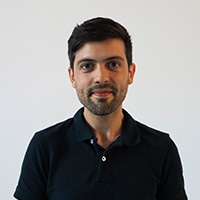
Hugo Filipe Matias Viana completed the MSc in Micro and Nanotechnology Engineering at NOVA School of Science and Technology
in January 2022, with a specialization in electronics and microelectronics. The MSc culminated with the thesis titled “Implementation
of Active Inductors with Oxide Thin-Film Transistors and Integration into Oscillator Circuits” under the supervision of Prof.
Pedro Barquinha and Prof. Pydi Ganga Bahubalindruni. The focus of this was to replace the traditional inductor in an LC-oscillator
with an active counterpart using oxide TFT technology based on a-IGZO semiconductor in the CADENCE VIRTUOSO environment. The
work resulted in a further improvement when compared to the state-of-the-art at the time. Already, during his degree, Hugo
entered into an internship at CEMOP-UNINOVA to produce and characterize cellulose-based TFTs in paper and cork substrates.
He was a research fellow from May 2022 to the end of 2023 at CTS-UNINOVA, under the IDS-Paper project (PTDC/CTM-PAM/4241/2020),
with Prof. João Goes as his supervisor. This work focuses on the design and simulation of several circuits such as comparators,
and DC-DC converters, among others also in CADENCE VIRTUOSO environment, using CMOS and oxide TFT technologies. Additionally,
he is providing mentoring to an undergraduate research student to the conclusion of a bachelor’s degree in Micro and Nanotechnology
Engineering titled “Design and simulation of circuit blocks for flexible oxide electronics”.
Currently, Hugo is pursuing a PhD degree at NOVA School of Science and Technology in Electrical and Computer engineering,
with a specialization in electronics. The PhD topic focus on analog-to-digital converter using deep-nanoscale CMOS and oxide-TFT
technologies.
Hugo's interests in the context of scientific, and technological are: Circuit design; flexible electronics; oxide thin-film
transistors; CMOS; Analog circuits; Mixed-signal circuits; Electronic oxides.
Campus da FCT Quinta da Torre
(+351) 21 294 8562
cenimat.secretariado@fct.unl.ptThis work is funded by national funds through FCT – Fundação para a Ciência e a Tecnologia, I.P., under project UID/50025 and the Associated Laboratory I3N – LA/P/0037/2020.