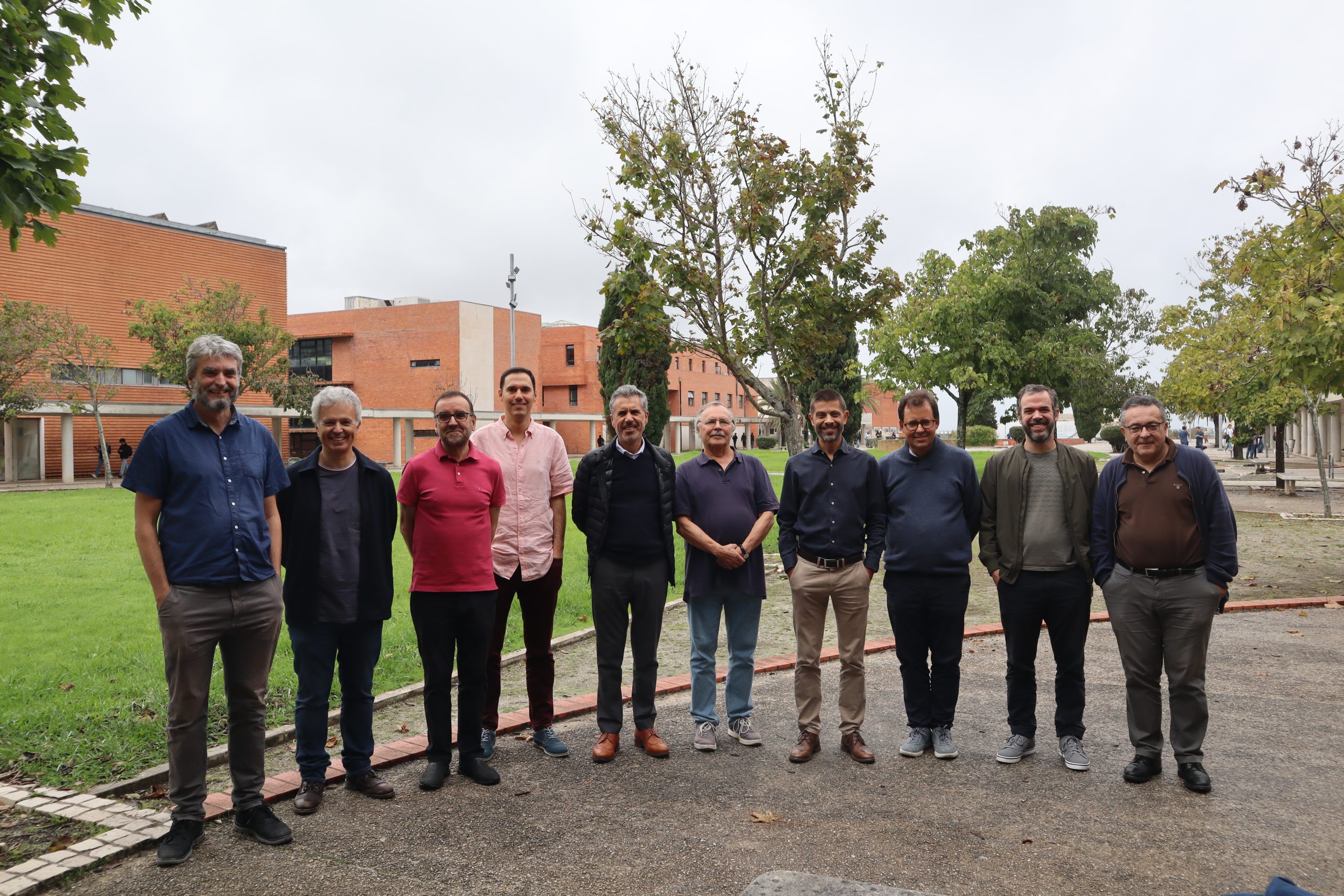
The Theoretical and Computational Physics (TCP) group of the i3N comprises 12 PhD members, two of which are full professors, two associate professors, three lecturers, five researchers, four of which are senior. Four PhD students are currently developing their work in the group areas. The TCP group also includes several master students. The group research aims at understanding and anticipating the physics of materials and devices through modelling and simulation. It also focuses on understanding complex systems with multiple interacting components. In material modelling, the group addresses several topics that contribute to the i3N thematic lines:
- Defect engineering in wide-gap semiconductors for power electronics and quantum technologies (TL3); electronic structure of semiconductor surfaces, and non-radiative losses in semiconductors for photovoltaics (TL2); novel transport phenomena and topological effects in 1D and 2D materials as well as in photonic crystals (TL3, TL1); numerical calculations of materials’ thermodynamic properties and studies of phase transitions in equilibrium and non-equilibrium systems using Monte Carlo and Molecular Dynamics methods (TL3, TL2).
In complex systems research, the group primarily studies statistical mechanics within complex networks and random graphs. This includes analyzing the structural organization and architectures of complex networks, their functional dynamics, cooperative behaviors among different agents within networks, and processes and spreading phenomena on these networks. The insights gained from theoretical and computational research on complex networks are applied to real-world network systems such as neural networks (including brain networks), cellular networks in molecular biology, information networks, transportation systems, and social networks.


 Campus da FCT Quinta da Torre
 (+351) 21 294 8562
 cenimat.secretariado@fct.unl.pt