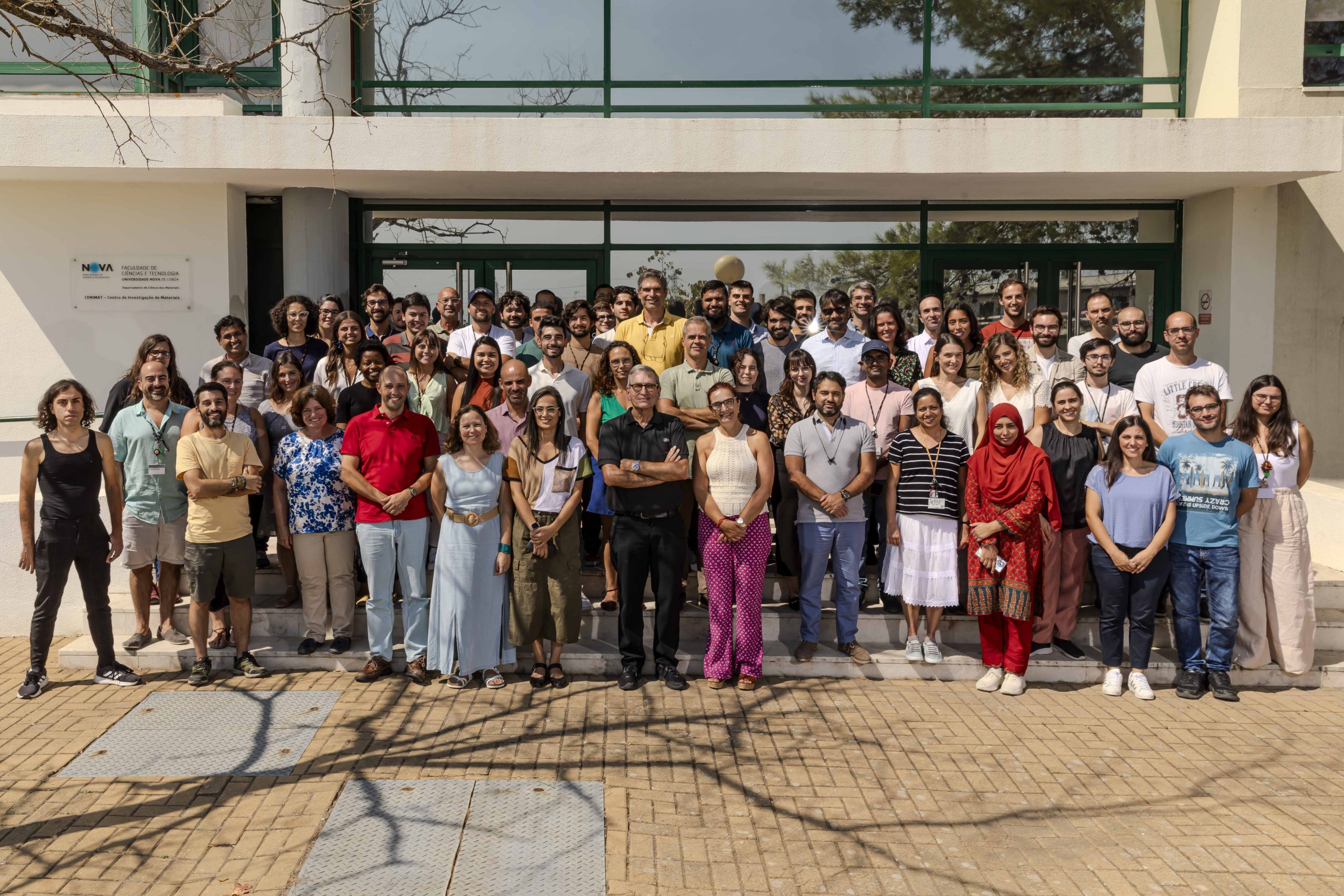
The Advanced Functional Materials for Micro and Nanotechnologies group (AFMMN) was renamed in 2023 to Materials for Electronics, Optoelectronics and Nanotechnologies (MEON) for coherence with the organisation of sections within the Materials Science Department, NOVA FCT. As April 2024, it is composed of 11 professors, 4 permanent doctoral researchers, 19 non-permanent doctoral researchers, 27 Ph.D students, 21 MSc fellowship researchers, 5 BSc fellowship researchers & 8 technologists, besides 10-15 MSc students/year.
MEON group pursues activity within the four thematic lines of i3N, having as pillars the responsible electronics directives from EU, working in applied research with economically and environmentally sustainable nanomaterials (TL3) & processes (TL1), with activity ranging from material design to system-level integration (TL1, 2, 4). The group has pioneering work in transparent and paper
electronics (TL1), exploring materials away from Silicon. In the last years it also expanded its activity to low-cost biosensing applications (TL4).
MEON is structured in three research areas (RA): RA#1 -Flexible and sustainable electronics; RA#2 (TL1 to 4)- Energy harvesting, conversion and storage (TL2,3); RA#3 – Bioelectronic and biomedical devices (TL4). These are transversally supported by three Satellite RA (SRA): SRA#1 – Nanomaterials synthesis/ deposition; SRA#2 (TL3)- Micro/nanopatterning (TL1,2); SRA#3 – Advanced characterization.
To enable its activity, the group has been building through competitive funding a world-class infrastructure adapted to low-temperature electronics, including a clean room (ISO6+7) with nm-level tools (e.g., ALD, DLW, NIL), as well as material chemical synthesis and printing laboratories enabling sub-μm printed conductors. All this is complemented by a wide range of tools for electrical, optical, structural, chemical and morphological evaluation of materials and devices (e.g., STEM, SEM/FIB, XPS, environmentally dependent IV & CV…).


 Campus da FCT Quinta da Torre
 (+351) 21 294 8562
 cenimat.secretariado@fct.unl.pt